

Cultivated meat starts expensive because R&D factors like costly cell nutrients, specialist factories and small batches all add to the cost per kilogram. Cutting costs means testing cheaper nutrient mixes, using the lowest effective doses and producing more meat without losing batches or reducing safety and quality.
One study found food-grade ingredients were 82% cheaper than laboratory-grade versions - but only for the ingredients assessed, not the finished product.
The main points:
- Ingredients: Compare total cost and cell growth, not just the price per gram.
- Production: Higher output can spread equipment and staffing costs, but larger systems bring extra challenges.
- Shelf price: Packaging, chilled transport and retail margins add to production costs.
Lower prices depend on progress across all three - not cheaper growth factors alone. No price or timeline is guaranteed.
Cost drivers of cultivated meat production
sbb-itb-c323ed3
Why Growth Media Ingredients Cost So Much
Growth media is the nutrient mix that feeds Cultivated Meat cells. Sugars supply energy, amino acids build new cells, and vitamins, minerals and proteins keep growth stable.
How Growth Factors Support Cell Growth
Growth factors such as FGF2 and TGF-β1 are signalling proteins. They tell cells when to divide or develop, and need specialist manufacturing, purification and activity testing.
Other proteins have different jobs. Insulin helps regulate nutrient use, transferrin carries iron, and albumin carries nutrients and helps stabilise the medium.
Albumin can dominate demand: one assessment found it accounted for 96.6% of the recombinant-protein volume required.[4]
So total cost per litre matters more than price per gram alone. Where and how an ingredient is sourced - not just its name - also affects the bill.
Why Research-Scale Inputs Cost More
Research ingredients often come in small quantities for laboratory or pharmaceutical use. Their prices reflect demanding specifications, extensive testing and specialist packaging.
One analysis found food-grade components were, on average, 82% cheaper than reagent-grade alternatives at a 1 kg purchase scale.[3]
| Input approach | Cost pressure | Potential improvement |
|---|---|---|
| Research-scale inputs | Small orders, high purity and extensive testing push up unit prices. | Buy larger volumes with specifications suited to safe food production. |
| Food-scale inputs | Reliable supply, traceability and consistent quality require investment. | Use validated food-grade equivalents where suitable. |
| Future lower-cost proteins or substitutes | Performance and safety still need validation. | Screen substitutes, then test in progressively larger systems. |
Food-grade does not mean fewer safety obligations. Nor does an 82% ingredient saving mean an 82% cut in shelf price. That figure applies only to the components assessed, not the full cost of making and selling Cultivated Meat.
Cheaper ingredients also leave the costs of running the production system: equipment, labour and small-batch production still add to the bill.
Facilities and Equipment Add to Costs
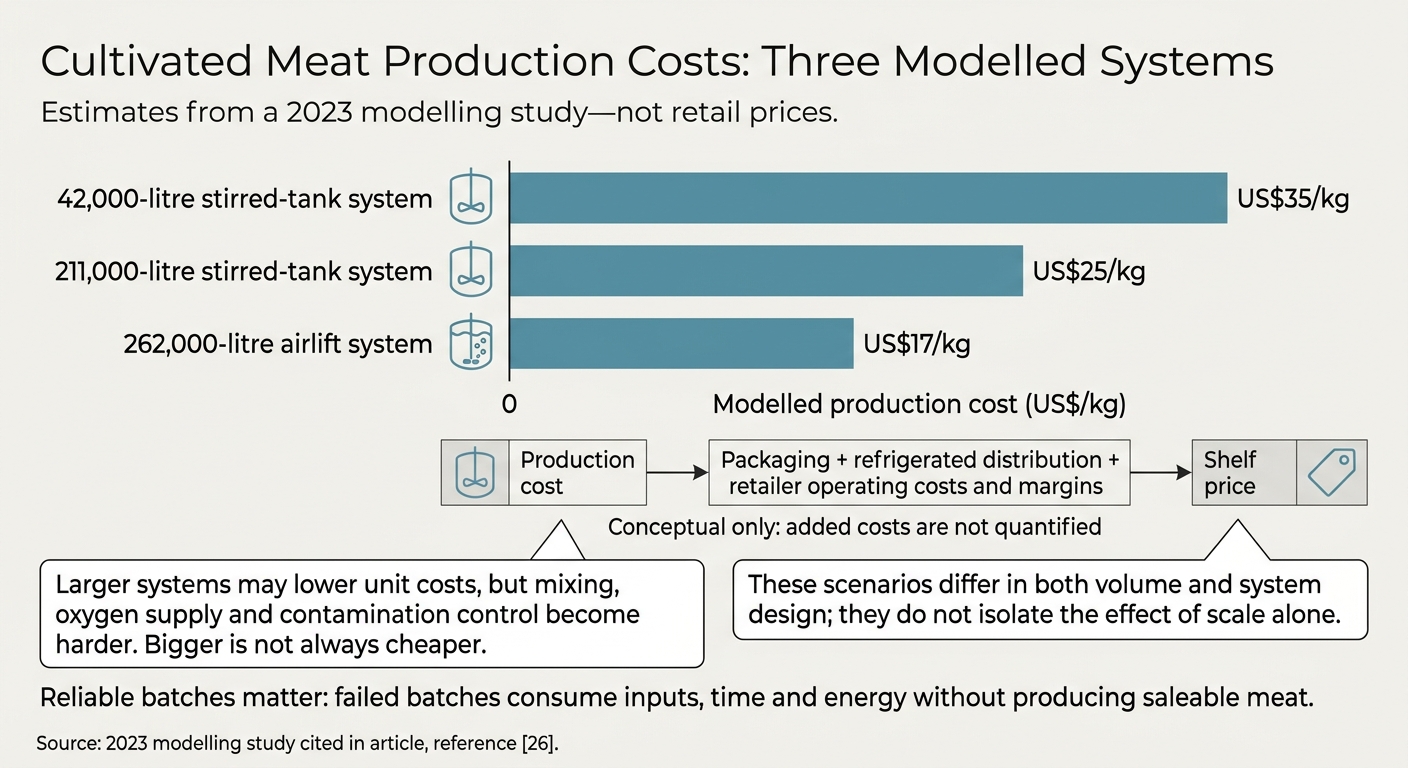
Cultivated Meat Production Costs: Three Modelled Systems
Cheaper growth factors do not remove the rest of the factory bill. Alongside different bioreactor designs, sites need systems for media preparation, sterilisation, harvesting and refrigeration. The costs of buying, maintaining and replacing this equipment are spread across output over time.
Keeping temperature, oxygen and pH steady takes energy, water and monitoring equipment. Sites also need skilled production, engineering and food-safety staff, plus laboratory checks for contamination and product quality. A failed batch uses inputs, time and energy without producing anything saleable.
Small Batches Mean Higher Costs per Kilogram
Small batches cost more per kilogram because fewer kilograms share the facility bill. Costs can fall as output grows, but only if production remains reliable. Making better use of equipment helps, though cleaning, maintenance and validation still take time. Any cost-saving change must pass reliability testing and may need further investment.
Why Production Costs Differ from Retail Prices
Larger systems may cut unit costs, but they make mixing, oxygen supply and contamination control harder. Bigger is not always cheaper: these systems also need supporting space, utilities and quality checks.
A 2023 modelling study estimated production costs of US$35/kg for a 42,000-litre stirred-tank system, US$25/kg for a 211,000-litre stirred-tank system and US$17/kg for a 262,000-litre airlift system.[5]
Production cost is lower than shelf price. These modelled figures are not what shoppers would pay. Packaging, refrigerated distribution, retailer operating costs and margins must also be covered. When checking a low-cost claim, look at whether it refers to modelled factory output or retail price - and whether it counts only batches that pass quality checks.
How Ingredient Screening Could Cut Costs
Further savings come from testing which ingredients can be reduced without harming cell growth. High-throughput screening compares many ingredient mixes to find the lowest-cost formulation that still supports reliable growth. It pinpoints which ingredients cells need, the doses that work and inputs that add little value, or identifying opportunities for nutrient recovery.[8][3]
Testing Ingredient Mixes, Amounts and Timing
Screening compares growth factors, nutrients, protein supplements and hydrolysates. It also tests concentrations and dosing schedules.
For example, a growth factor might be added continuously, in stages or at a lower dose once cells are established.[8][3][11]
The best mix depends on the cell type, growth stage and bioreactor conditions. Screening therefore tests both cost and growth - not just whether cells grow, but at what expense.[8][3][11]
Choosing Inputs by Total Cost and Performance
The lowest unit price isn’t always the lowest total cost. Compare cost per litre, per kilogram of biomass and per successful batch. Include storage, testing, transport and waste in the calculation.[8][9][10]
Checking Savings at Production Scale
Promising mixes must still meet food-safety, yield and quality requirements at production scale. Suppliers also need to deliver enough material to specification. Buying larger quantities can cut prices through supplier deals and more efficient production. But storage needs, shelf life and quality checks can eat into those savings.[9][10][7]
Formulation savings and equipment-efficiency gains are separate ways to cut costs. Each needs proof before the savings are combined.[6][7]
Conclusion: Lower Prices Depend on Several Changes
Cultivated Meat prices are high at this early stage because several costs add up: expensive growth media, specialised facilities and low production volumes.
Ingredient screening, careful input selection and reliable scale-up could bring prices down. Higher yields and less downtime would spread costs across more output without compromising safety or quality. But no specific price or timeline is guaranteed.
FAQs
Will cheaper nutrients change how Cultivated Meat tastes?
The aim is to cut costs without changing the taste or quality of Cultivated Meat. Lower-cost, food-grade nutrients must still meet strict regulatory and safety standards.
By screening and carefully selecting ingredients, manufacturers can choose nutrients that support healthy cell growth and consistent quality. These checks also help avoid impurities or variations that could affect taste or texture.
How will I know if Cultivated Meat price claims are realistic?
Look beyond the marketing figures. Realistic forecasts should include the full cost of manufacturing, including growth factors and media. They should also explain how affordable, food-grade ingredients and efficient cell lines could bring costs down.
Check for evidence of consistent, large-scale production - not just a single successful run. Facilities need to run close to capacity to spread equipment and labour costs across more saleable kilograms. Retail prices must also cover packaging, distribution and margins.
Could some Cultivated Meat products become affordable sooner than others?
Yes. Hybrid products that combine Cultivated Meat with plant-based ingredients, along with unstructured products such as burgers or sausages, typically need fewer cultivated cells. This makes them cheaper to produce as the technology matures [1].
Early standalone products often cost more because they’re made on a small scale. Over time, cell engineering, more efficient growth media and large-scale, continuous manufacturing are expected to bring prices down across all categories [1][2].


