

Sustainability claims in the food industry face significant scepticism. For cultivated meat, which promises reduced emissions, lower resource use, and improved animal welfare, trust is essential but hard to earn. Consumers are wary due to past greenwashing, unclear messaging, and a lack of transparency. Here's what stands out:
- Trust Gap: Only 9% of global consumers trust sustainability claims, with 64% of UK consumers expressing doubt.
- Challenges: Misleading claims, complex production processes, and inconsistent labelling fuel scepticism.
- Opportunities: Clear, specific, and evidence-backed claims can win over neutral consumers (31% globally).
- Solutions: Use independent verification, transparent labelling, and accessible communication to address concerns and build confidence.
To succeed, cultivated meat brands must prioritise honesty, provide solid data, and engage consumers with straightforward messaging. Without these efforts, even the most promising claims risk being dismissed.
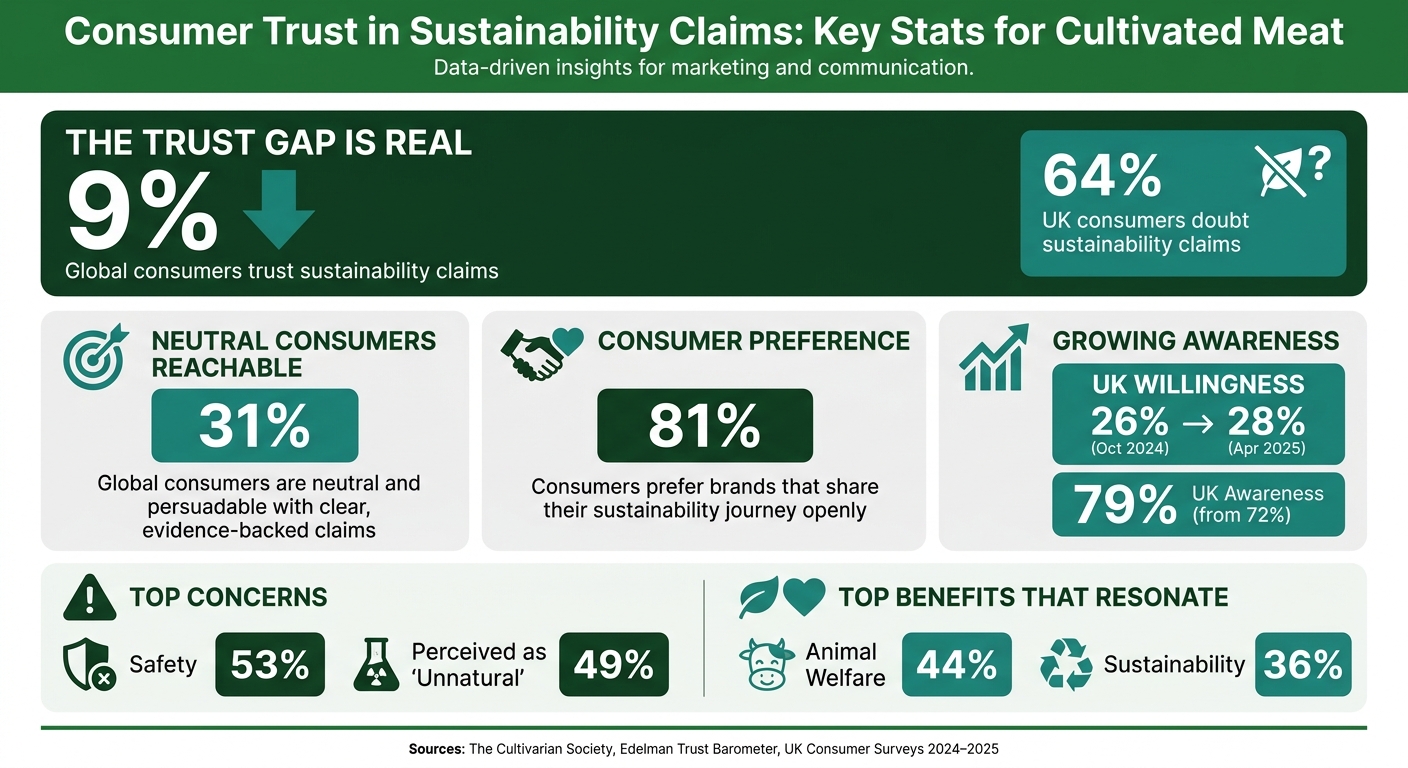
Consumer Trust in Sustainability Claims: Key Stats for Cultivated Meat
Consumer Information for Trust, Safety, and Sustainability #WorldConsumerRightsDay 2025
sbb-itb-c323ed3
Why Consumers Doubt Sustainability Claims
As mentioned earlier, 64% of UK consumers are sceptical about sustainability claims. But what’s fuelling this doubt?
Greenwashing and Misleading Claims
The food industry has a history of making bold sustainability promises without backing them up. Words like "natural", "cruelty-free", or "carbon neutral" are often plastered on packaging with little to no evidence to support them. This pattern of greenwashing has made consumers distrustful of environmental claims, even when they’re legitimate.
For Cultivated Meat, this scepticism creates a tough hurdle. Even honest claims can be dismissed if shoppers feel they’ve been misled in the past. One key issue is transparency around ingredients. For instance, products marketed as "slaughter-free" but containing animal-derived growth media, such as fetal bovine serum, can leave consumers feeling betrayed. Similarly, packaging that features idyllic farm imagery can give a false impression of how the product is actually made [2].
"Misleading claims, however, can confuse consumers. Examples include vague terms like 'natural' or 'cruelty‐free', hiding animal‐derived inputs, or using packaging that mimics traditional meat." - The Cultivarian Society [2]
Adding to the problem, the technical nature of how cultivated meat is made makes it even harder for consumers to understand.
Complexity and Lack of Transparency
Producing Cultivated Meat involves bioreactors, cell extraction, and nutrient-rich growth media - processes that are far from easy to sum up on a label. When brands fail to explain this complexity in simple terms, consumers are left intrigued but unsure about how these products are actually made [1].
Without accessible data, like life-cycle analyses on emissions or water usage, sustainability claims can feel empty. Even when the claims are accurate, they may be dismissed as mere marketing spin [2]. Bridging this gap is crucial for building the trust that Cultivated Meat brands rely on.
These challenges are further compounded by inconsistent regulatory standards.
Regulatory and Market Constraints in the UK
UK and EU food labelling laws require claims to be truthful and not misleading. However, when it comes to Cultivated Meat, there are no standardised terms that brands must use. This lack of consistency only adds to consumer confusion [2].
Elsewhere, regulators are starting to tighten the rules. For example, in the United States, states like Colorado, Oklahoma, and Utah introduced legislation in 2025 requiring Cultivated Meat products to display clear terms like "cell-cultivated" prominently on packaging. Products that fail to comply are classified as "misbranded" [2]. While the UK hasn’t yet adopted similar mandatory standards, the writing is on the wall: transparency is becoming a legal requirement, not just a nice-to-have. Brands that adapt early are more likely to earn consumer trust. Platforms like Cultivated Meat Shop are already stepping in to help consumers understand the landscape through clear, evidence-based resources.
How to Make Sustainability Claims More Credible
Earning consumer trust in Cultivated Meat requires clarity and strong, evidence-supported claims. With scepticism on the rise, brands need to rely on solid data, be transparent about challenges, and embrace independent verification to build credibility.
Backing Claims with Solid Evidence
The best way to make sustainability claims convincing is to base them on reliable data. For Cultivated Meat brands, this means conducting independent Life Cycle Assessments (LCAs) to measure energy use, water consumption, and greenhouse gas (GHG) emissions. Research suggests Cultivated Meat could result in:
- 78–96% fewer GHG emissions
- 82–96% lower water usage
- 98–99% less agricultural land use [3].
That said, there’s an important nuance to keep in mind. As experts in Sustainability Science explain:
"The advantages of Cultivated Meat over conventional meat are based on a scenario in which technological developments have helped overcome hurdles such as cost-effective upscaling and the development of an animal-free nutrition medium." [3]
In simpler terms, many of these figures are based on future, large-scale production scenarios, not the current state of the industry. Brands that acknowledge these projections as aspirational rather than definitive will likely gain more trust from consumers. This transparency sets the stage for open conversations about production processes.
Being Honest and Open in Messaging
Transparency also means addressing any unexpected aspects of production. For example, Cultivated Meat often involves growth media that may include animal-derived substances. Being upfront about these details, rather than glossing over them, helps avoid accusations of "ethics-washing", which can damage trust.
A practical way to share this information is by incorporating QR codes on packaging. These codes can direct consumers to detailed data on sustainability, safety, and supply chains [2]. This method provides curious buyers with the information they seek without overwhelming the product label.
Using Independent Verification and Standards
Self-reported claims only go so far. To truly reassure consumers, brands should lean on third-party certifications and external audits. These independent checks validate claims and show that they’re more than just marketing spin. For environmental claims, peer-reviewed LCA data is particularly impactful, offering scientific credibility [3].
Meeting regulatory standards is just the starting point. As labelling rules become stricter in the UK and elsewhere, brands that go beyond compliance will stand out as more trustworthy. The table below highlights how different verification methods influence consumer confidence:
| Verification Method | Focus Area | Impact on Credibility |
|---|---|---|
| Peer-Reviewed LCA | Environmental (GHG, land, water) | High - provides scientific legitimacy [3] |
| Third-Party Audits | Safety, labour, and welfare | High - confirms claims aren't just marketing [2] |
| Regulatory Compliance | Labelling and naming standards | Essential - ensures compliance and clarifies claims [2] |
| Voluntary Frameworks | Ethical and social commitments | Moderate - signals genuine industry intent [2] |
Building trust starts with honest, evidence-based claims that are verified by independent parties. These steps form the backbone of a credible sustainability message, helping consumers feel confident in their choices.
Platforms like Cultivated Meat Shop are already making strides in this area by offering clear, science-backed information about how Cultivated Meat is produced. This approach allows shoppers to assess sustainability claims with greater confidence.
Steps for Running Trustworthy Sustainability Campaigns
Once you've established evidence-based claims, the next step is to communicate them clearly. This is especially important for addressing consumer scepticism surrounding Cultivated Meat. Even the most reliable data can fall flat if it's buried in technical jargon, hidden in fine print, or presented as a one-way message. Clear communication, backed by strong data and independent verification, is the key to bridging the gap between evidence and consumer trust.
Making Claims Clear and Specific
Avoid using vague or generic terms. Instead, focus on specific, measurable claims, such as reductions in greenhouse gas emissions compared to traditional beef. This level of precision helps distinguish authentic claims from greenwashing. For instance, using qualifiers like "cell-cultivated" immediately before the product name - displayed in a font size at least as large as the meat term - ensures clarity and complies with UK food-information regulations [2].
"Transparent labelling is not just a legal requirement - it's a responsibility to consumers and a step towards creating a trustworthy cultivated meat market." - The Cultivarian Society [2]
Before rolling out any claims, involve multiple departments in a review process. Ask questions like, "Could this be confused with conventional meat?" or "Is the description simple enough for everyday understanding?" This approach can help identify and resolve potential issues before they arise.
Translating Complex Science into Plain Language
Most shoppers won't dive into a detailed life-cycle assessment, but that doesn't mean the science behind it isn't important. The challenge lies in making this technical data accessible. Translate it into easy-to-grasp metrics, like the number of animals spared per kilogram of meat or the water savings achieved. This makes the information more relatable and impactful for consumers [2].
When explaining the production process, keep it straightforward. For example, describe how cells are taken from a small biopsy and grown in a nutrient-rich medium. This approach helps demystify Cultivated Meat. Pair these explanations with visuals that accurately depict the bioreactor-based production process, steering clear of imagery that might evoke traditional farming. Adding QR codes that link to in-depth data can further enhance transparency [2].
Opening Up Two-Way Dialogue with Consumers
Building trust requires more than just broadcasting information; it demands genuine engagement. Research shows that 81% of consumers prefer brands that share their sustainability journey rather than presenting themselves as having all the answers [4]. This highlights the importance of creating opportunities for dialogue.
Consider organising citizen panels, conducting tests with diverse consumer groups (including those from lower-income households who often rely heavily on front-of-pack information), and collaborating with NGOs to address concerns about food safety and affordability [2]. Regularly sharing updates - including honest discussions about ongoing challenges - shows a commitment to continuous improvement.
Platforms like Cultivated Meat Shop can play a vital role in fostering this dialogue. By offering educational resources, they empower consumers to ask informed questions and engage meaningfully with sustainability claims.
Measuring Whether Sustainability Claims Are Working
For Cultivated Meat, where scepticism often runs high, gauging trust is a must. To see if your messaging is making an impact, you need to track the right signals - ranging from how people talk about it to how they behave. This data-driven approach complements earlier efforts to back up sustainability claims with clarity and evidence, helping to build trust over time.
Measuring Consumer Trust
Digital engagement can provide valuable insights. For example, if you’ve included QR codes linking to detailed sustainability data, tracking how often those codes are scanned can tell you a lot. Are people looking for more information, or are they satisfied with what’s already provided? These patterns of engagement allow you to refine your messaging based on real consumer interest and behaviour.
Monitoring Changes in Consumer Behaviour
Shifts in consumer behaviour offer another way to measure trust. Take the UK as an example: the percentage of people willing to try Cultivated Meat increased from 26% in October 2024 to 28% by April 2025 [6]. During the same period, awareness of the category grew from 72% to 79% [6]. When more people know about the product and are willing to give it a shot, it’s a clear sign that your messaging is hitting the mark. These changes tie directly to earlier efforts to use clearer language and improve transparency.
Refining Messaging Through Feedback
Consumer feedback is a goldmine for identifying gaps in understanding. Current data highlights key concerns about Cultivated Meat: safety (53%) and the perception of it being "unnatural" (49%) [6]. On the other hand, the benefits that resonate most with consumers are animal welfare (44%) and sustainability (36%) [6]. If a campaign focuses heavily on environmental benefits but neglects safety concerns, it risks missing the mark with its audience.
"Trust isn't won with purpose statements – it's earned through relevance, responsiveness, and relentless clarity of action." - 2025 Edelman Trust Barometer Special Report [5]
To keep building trust, it’s essential to align your messaging with what consumers care about most - whether that’s safety, sustainability, or something else entirely. For example, if safety is the top concern, campaigns should prioritise safety assurances and highlight independent verification. Regular consumer testing, citizen panels, and cross-departmental reviews can ensure that these adjustments are grounded in real feedback, not assumptions. Platforms like Cultivated Meat Shop also play a key role by offering educational content that addresses evolving consumer questions, helping to close the gap between what brands communicate and what shoppers want to know.
Conclusion: Why Honest Sustainability Stories Build Lasting Trust
Trust in sustainability claims doesn’t happen overnight - especially in the Cultivated Meat industry, where the stakes are high. With a backdrop of greenwashing and consumer scepticism, it’s no surprise that people demand clear, credible communication. The way forward? Evidence, openness, and consistency.
Successful sustainability campaigns are built on solid foundations: backing every claim with accessible data, avoiding jargon, and being upfront about imperfections. This approach is crucial for Cultivated Meat, where the idea of producing real meat from cells is still new to many. Consumers don’t need every technical detail, but they do need clarity. Using terms like "cell-cultivated" on labels and providing verifiable life-cycle data are simple but effective ways to build trust. Welcoming scrutiny rather than shying away from it is another way to show confidence in the product.
Education is key. Resources like Cultivated Meat Shop are helping close the gap between what producers say and what consumers want to know. By offering clear, science-based explanations, they make cultivated meat less mysterious and easier to understand. This kind of honest engagement transforms curiosity into confidence, laying the groundwork for long-term success.
FAQs
What makes a sustainability claim trustworthy on cultivated meat?
A reliable sustainability claim hinges on transparency, precision, and solid evidence. Labelling should clearly identify the product as cultivated meat, including detailed information about its ingredients, how it’s produced, and any regulatory approvals it has received. Steer clear of ambiguous terms like "natural" or "cruelty-free" unless they’re backed by proof. Instead, emphasise measurable advantages - such as lower emissions or improved animal welfare - supported by recognised certifications and straightforward communication about safety and environmental considerations.
How can I check if a cultivated meat claim is independently verified?
To confirm a cultivated meat claim, check for certifications such as FSA approval, HACCP, or ISO 22000 on the packaging. These labels indicate the product meets rigorous safety and quality standards. Also, ensure the claim is supported by transparent, science-backed details from reliable sources like regulatory bodies or well-established organisations.
Why do some sustainability figures for Cultivated Meat depend on future scale?
Sustainability data for cultivated meat is closely tied to the potential for large-scale production. The environmental advantages - such as reduced greenhouse gas emissions, less land usage, and lower water consumption - hinge on achieving efficient, high-capacity manufacturing. Current figures are primarily based on projections that assume future advancements in production methods, which would streamline resource use and enhance sustainability. While these benefits could become more concrete as the industry expands, they are currently speculative due to the early developmental phase of the technology.


